
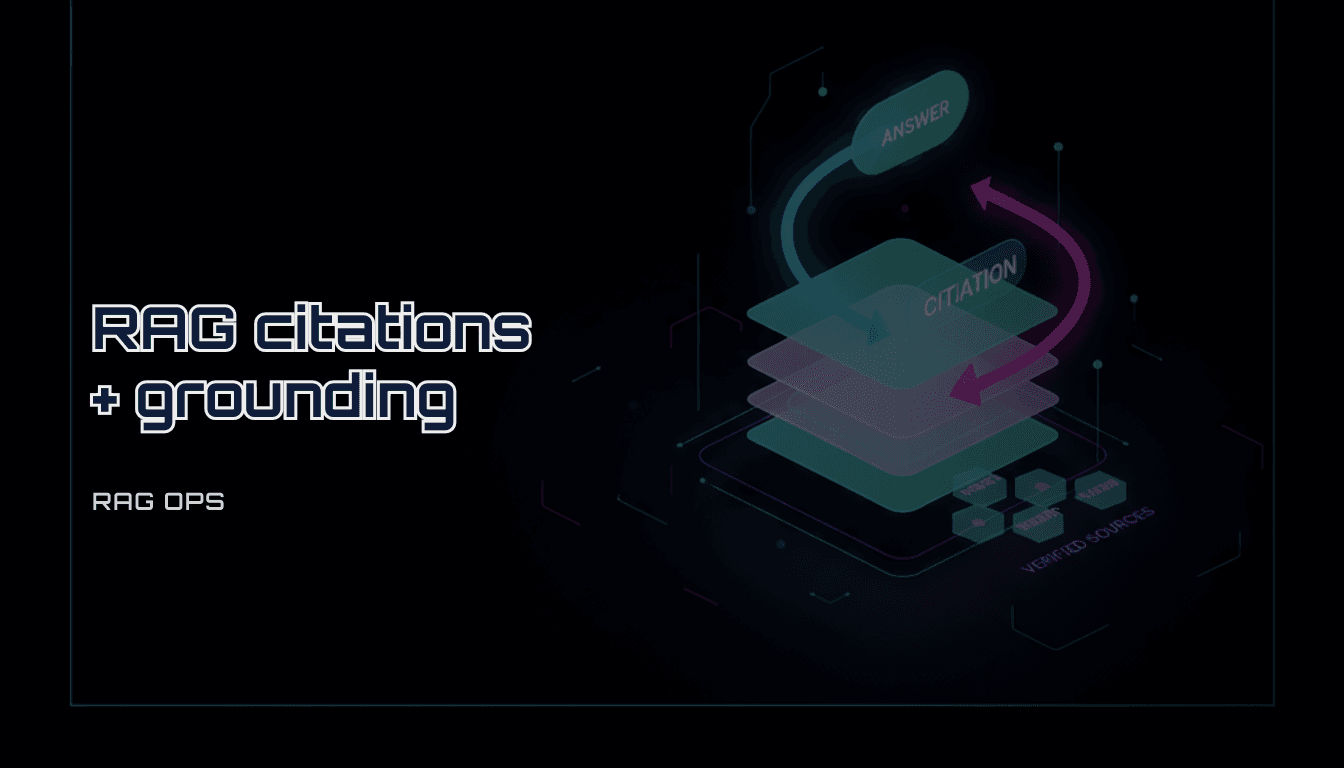
RAG citations and grounding: a practical checklist for trustworthy answers (2026)
A practical checklist to make RAG answers trustworthy. Enforce citations, track doc_ids, handle conflicts, and prevent the model from inventing sources. Includes logging and UX patterns that scale.
Table of Contents
- How do you make RAG answers trustworthy with citations and grounding?
- Conclusion
- Explanation
- Practical Guide
- Step 1: define what must be cited (10 minutes)
- Step 2: design citation objects (10 minutes)
- Step 3: force the model to output citations (10 minutes)
- Step 4: handle conflicts explicitly (10 minutes)
- Step 5: implement “answer modes” (10 minutes)
- Step 6: log the evidence (5 minutes)
- Pitfalls
- Checklist
- FAQ
- 1) Do citations guarantee correctness?
- 2) What’s the fastest first improvement?
- 3) Should I show citations to users?
- Internal links
- Disclaimer
How do you make RAG answers trustworthy with citations and grounding?
Conclusion
RAG improves accuracy only if users can tell where the answer came from. The minimum grounding system is:
- enforce citations for factual claims
- link citations to stable doc_ids + chunk_ids
- refuse or ask a question when sources don’t support the claim
- log retrieved_doc_ids so you can explain “why” later
If you don’t ground, you still get hallucinations, just with better-sounding text.
Explanation
“Grounding” means the model’s answer is constrained by retrieved sources. “Citations” make that constraint visible and auditable.
RAG fails in common ways:
- the model answers without using sources
- the model invents citations (“source laundering”)
- retrieved sources conflict and the model picks one silently
- retrieval returns irrelevant chunks and the model fills gaps
The fix is a pipeline + UX pattern, not a better prompt.
Practical Guide
Step 1: define what must be cited (10 minutes)
Pick rules that are easy to enforce:
- factual statements must have at least 1 citation
- numbers, dates, policy claims require citations
- “recommendations” can be uncited but must be labeled as suggestions
Rule:
- no citation = treat as ungrounded
Step 2: design citation objects (10 minutes)
Do not cite with plain URLs in free text. Return structured citations:
- doc_id
- chunk_id (or byte/page offsets)
- title
- source_type (wiki, ticket, upload)
- retrieval_score
This is what makes citations verifiable.
Step 3: force the model to output citations (10 minutes)
Two practical patterns:
- JSON output with
answer+citations[] - inline markers like [1][2] plus a citations table
Add a hard validation step:
- reject responses that reference missing citation IDs
- reject citations that weren’t in the retrieved set
This prevents invented sources.
Step 4: handle conflicts explicitly (10 minutes)
When sources disagree, do not “pick a winner” silently. Choose one:
- show both sources and ask the user which applies
- pick the newest doc by policy (if safe)
- escalate to human review for high-risk topics
Also store doc metadata:
- updated_at
- owner
- version
Step 5: implement “answer modes” (10 minutes)
Have explicit modes:
- grounded mode (citations required)
- summary mode (citations optional)
- draft mode (no actions, cautious language)
Sensitive workflows should default to grounded mode.
Step 6: log the evidence (5 minutes)
Minimum logs per request:
- request_id
- retrieved_doc_ids + chunk_ids
- retrieval scores
- citations returned
- “ungrounded claim” validation failures
If a user disputes an answer, you can show the doc_ids.
Pitfalls
- allowing citations that were not retrieved
- citation by URL only (breaks when content changes)
- no chunk identifiers (can’t verify)
- answering despite weak retrieval scores
- hiding conflicts between sources
Checklist
- [ ] I defined which claims require citations
- [ ] Citations reference doc_id + chunk_id (not just URLs)
- [ ] The model output format includes
citations[] - [ ] Responses are validated: citations must be from retrieved set
- [ ] Ungrounded claims are blocked or converted to questions
- [ ] Conflicting sources are handled explicitly
- [ ] Doc metadata includes updated_at and owner
- [ ] Grounded mode exists for sensitive topics
- [ ] Logs include retrieved_doc_ids and citations
- [ ] We can explain “why” with doc_ids within 10 minutes
FAQ
1) Do citations guarantee correctness?
No. They guarantee traceability. Correctness improves when you enforce “no citation, no claim” for facts.
2) What’s the fastest first improvement?
Log retrieved_doc_ids and require citations for numbers/dates/policy claims.
3) Should I show citations to users?
Yes for enterprise and internal tools. For consumer UX, you can hide them behind a “Sources” drawer.
Internal links
- Hub: AI development
- Related:
Disclaimer
General engineering guidance only.
Popular
- 1Permit2 explained (Web3): why approvals changed and how to use it safely (checklist)
- 2Read wallet signing screens (Web3): a 30-second checklist to avoid permission traps
- 3Spec-to-implementation prompt template (AI development): how to stop the model from guessing
- 4Revoke token approvals on EVM: how to audit allowances safely (checklist)
- 5Clarifying questions checklist (AI development): what to ask before you let an LLM build